


text Rossella Battista photo Valentina Stefanelli



Michelangelo's masterpieces in Rome
An itinerary to discover the artist's most important works and the most surprising anecdotes about his genius
A bad-tempered genius, Michelangelo Buonarroti (1475-1564) was cantankerous, aggressive, touchy and greedy. His talent, however, allowed him to do anything he wanted to, whether it was defying Pope Julius II or writing passionate poetry for Tommaso dei Cavalieri, who would stay by his side till the end. A shy and introvert person, he would rather live in a humble house-workshop near the Forum, offered by Julius II, than buy himself a palazzo, which he could easily afford.
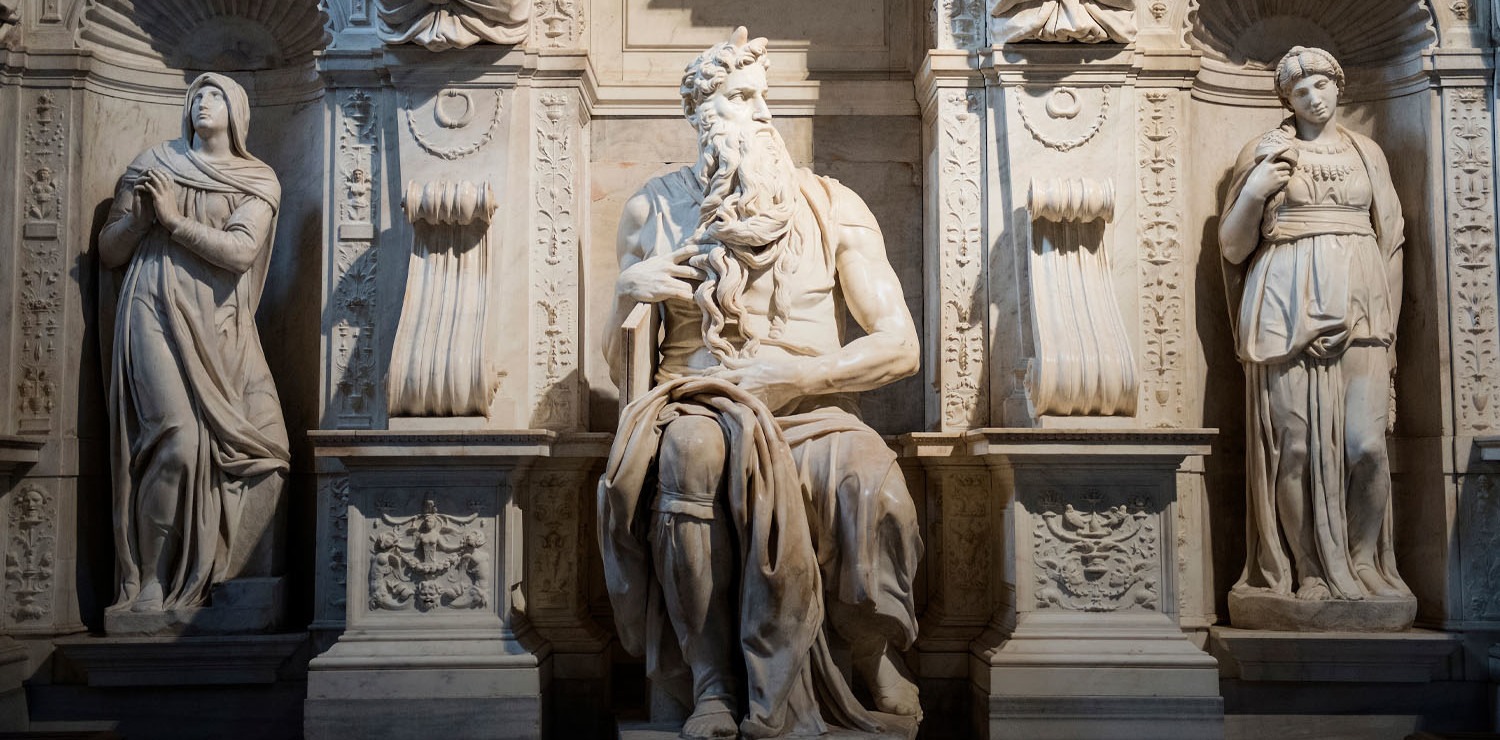
His was a life of exile, always in conflict—mostly with himself: his denied homosexuality, his impoverished aristocratic background, a father never satisfied with what he gave him. He envied the luckier, beloved Raphael, while exhausting himself in Carrara’s quarries searching for marble for the Pope’s tomb. Michelangelo was a genius, but also tormented and insecure. One thing he never compromised on was money. He always got overpaid. The Della Rovere family paid over 8,000 scudi for a mausoleum meant to have 40 statues, which ended up with barely a fifth of them, and in San Pietro in Vincoli, where Julius had been cardinal. In the end, Michelangelo bested the Pope too: despite tensions and threats to abandon the project, Julius entrusted him with the Sistine Chapel ceiling - a task Bramante advised against, as Michelangelo had little experience with fresco. Michelangelo, however, had Condivi - an even more generous biographer than Vasari—claim that Bramante (Raphael’s patron) had proposed his name just to ruin him.
Michelangelo would have Condivi write half-truths. He stressed the artist’s noble origins and skirted his involvement with the ‘Spirituali’: the group of intellectuals led by Vittoria Colonna, his dear friend, and by Reginald Pole, the English cardinal who sought dialogue with the Lutherans whom Cardinal Carafa, once he became Paul IV, declared heretic. So Michelangelo stopped composing sonnets, but he risked too to be put on trial: it was the time when Cosimo I did everything in his power to help him to safety back in Florence. But Michelangelo, busy with St. Peter’s, refused his help.
Those were the darkest years: Michelangelo was an old man by then and he began carving his most famous Pietà sculptures, Palestrina, Rondanini and Bandini, which he intentionally damaged when he found out that Cardinal Morone, a member of Vittoria’s group, had been imprisoned. He would then donate the work to his Florentine friend Bandini.
 The Pietà (1499) in the St. Peters Basilica
Michelangelo, however, was also a clever man, he was always able to get by, ever since he sold a fake antique putto to Cardinal Riario (the Pazzi Conspiracy one) who, instead of convicting the artist, took him under his wing. A genius is forgiven everything. For Julius II’s nephew, Michelangelo carved the drunken Bacchus and designed the Palazzo dei Conservatori and Piazza del Campidoglio. Iacopo Galli, a Florentine at the service of the RomanCuria,would always intercede for him andgot him his first dazzling masterwork: the Vatican’s Pietà. The Virgin Mary seems holding an Adonis in her arms rather than a dead son. It met with amazing success. And in fact, just when Michelangelo was heading back to Florence to carve the David, the della Rovere Pope commissioned him to create his gigantic tomb. The agreement provided for the artist’s exclusive commitment, but Michelangelo had no trouble in breaking the contract: he immediately accepted to carve the Jesus Christ, today in the Church of Maria Sopra Minerva, for Metello Vari who, however, would have to wait 10 years to see it completed.
And so, advance payments, but never-ending works. Also because the popes changed quickly (13 throughout the artist’s long life) and every new one wished to leave a mark of his papacy, expensive and grandiose at the same time. And Michelangelo became richer and richer. But he invested everything for his family that he hoped to redeem. He built the house on Via Ghibellina, and then bought one in Settignano and several farms, including Pozzolatico, and he schemed to arrange wealthy marriages. But he achieved the goal only with his niece, who married a member of the Guicciardini family, and for Leonardo he sought a woman who would be ‘ plain and undemanding, but from a noble lineage’. Then Leonardo made the daughter of a stone-cutter pregnant, much to his uncle’s great disappointment.
 Michelangelo painted the ceiling of the Sistine Chapel between 1508 and 1512
And while Michelangelo never trusted his relatives, he was tricked by his faithful servants, such as Urbino, who made money behind his back. And his nephew Leonardo’s sincere affection was of no use to him. He sent back the thick woolens to him saying ‘ an aristocrat wears only the finest linens and woolens’ and didn’t want him by his sick-bed, fearing that he would count his possessions. But his nephew put up with the humiliations. He regularly sent him cheese, in particular, the marzolino cheese he was so greedy for and Trebbiano wine. But when Leonardo arrived at his uncle’s dark house to take the dead body away, he found him dressed in shabby clothes and the linens untouched. He was said to never take his shoes off. And in fact, he bought nothing in Rome. Lucky for him that Vittoria, although much younger, pampered him as a child. And when he fell sick, she put him into the Strozzi’s house along the Tiber river and when she realized that his sight was deteriorating because of the hard work on the Pauline Chapel, commissioned by Paul III, he asked Pole to lent her his glasses and had lenses especially made for him in Venice. He was pampered and loved also by the Medicis, with whom he had grown up, but whom he always opposed because of his republican ideas. And they forgave him: Leo X commissioned himwith the tombs and the façade of the Church of San Lorenzo, Clement VII with the Last Judgment. A work that met with the censure of Carafa, who hired Daniele da Volterra, better known as Braghettone, to cover all the nude figures with breeches. A work that reflects the crisis of that period of time: a flurry of halo-less saints who mingle with the damned, angels without wings who can hardly hold the tools of martyrdom. They are all dumfounded, incredulous, worried.
But all popes, before and after the Council of Trent, except for Paul IV, adored him: Paul III enjoyed his conversation with him, the extravagant Julius III had him carve two tombs in San Pietro in Montorio and Pius IV entrusted him with the design of the Church of Santa Maria degli Angeli, which the artist would not be able to complete.